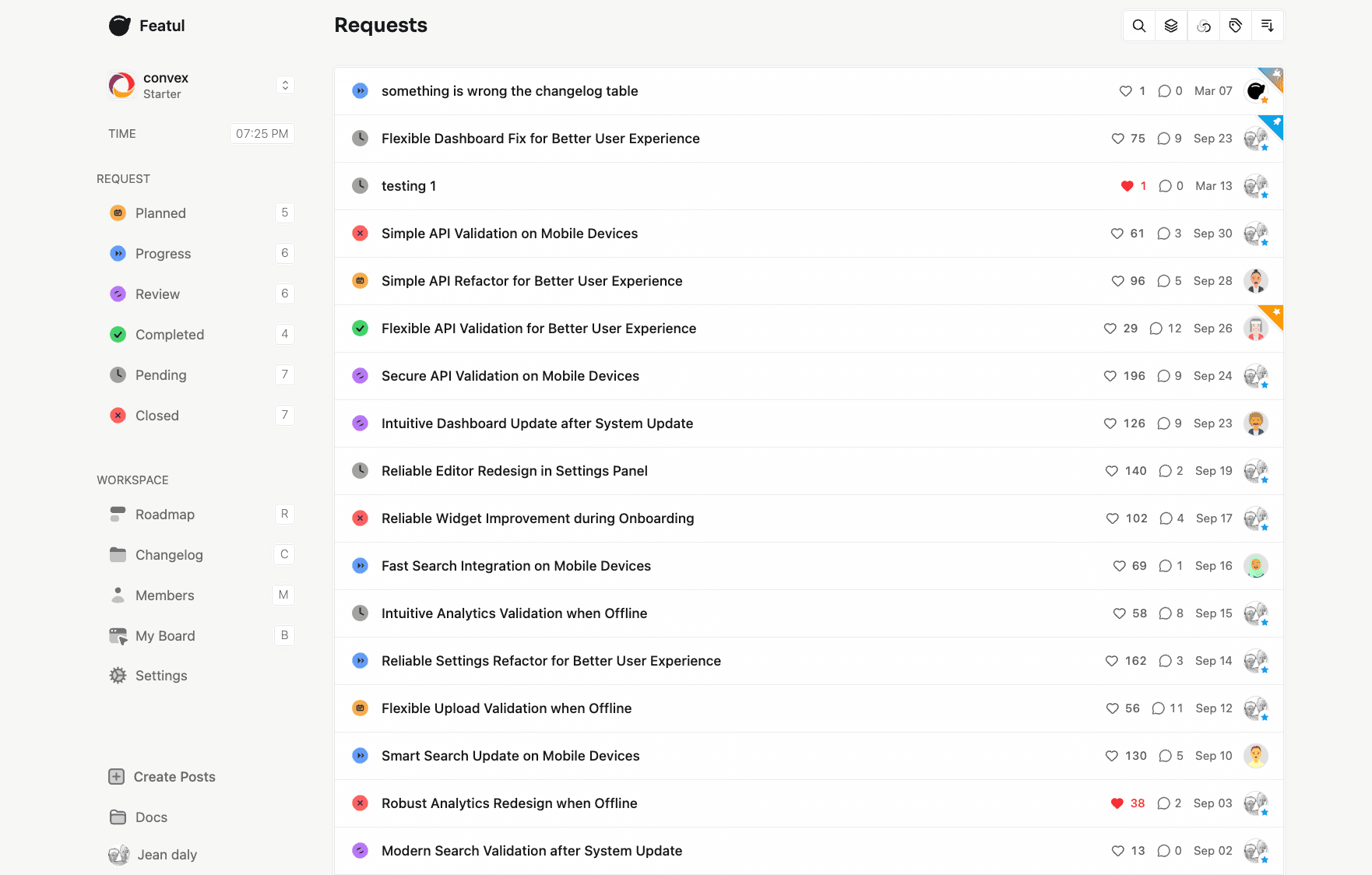
What It Is
Featul is a privacy-first customer feedback platform built for teams that want to collect user requests, organise product decisions, publish a roadmap, and close the loop with changelog updates in one place.
Rather than treating feedback as a loose inbox, Featul is structured like a product operating system: it gives teams a way to collect ideas, connect them to roadmap work, manage workspace settings and members, and communicate progress publicly.
Why I'm Building Featul
I decided to build Featul because a lot of open-source customer feedback platforms feel old, both in product direction and in interface quality.
Many of the OSS options available today feel dated, and I wanted to create something that feels more current, more thoughtful, and more in tune with how modern teams want to collect and manage feedback.
Featul is my way of bringing a fresh twist to the customer feedback space: a product that feels modern, open source, and more exciting than the tools that already exist.
It is also being built toward a full release planned for May, which makes this project feel less like an experiment and more like a real product I want to keep pushing forward.
What It Does
- Collects feature requests, bugs, and feedback through boards and submission flows.
- Supports public roadmaps and changelog pages that can be exposed on workspace subdomains.
- Handles signed-in workspace management, onboarding, invites, branding, and settings.
- Includes widget routes and embedded feedback flows.
- Runs a separate marketing/docs/blog site for acquisition, education, and conversion.
How It Is Built
Featul is built as a Turbo monorepo using Bun workspaces, with two main applications and a set of shared internal packages.
The main product experience lives in apps/app, which is a Next.js 16 app-router application using React 19 and TypeScript. That app covers the signed-in dashboard, auth flows, workspaces, requests, roadmap and changelog routes, widget endpoints, and public workspace-facing pages.
The public site lives in apps/web, also on Next.js 16, and handles the landing page, docs, blog, pricing, legal content, integrations pages, use cases, glossary pages, and SEO-driven tools and content templates.
Monorepo Structure
One of the most interesting parts of Featul is how much logic is pushed into shared packages instead of being trapped in one app.
The repository includes:
@featul/apifor routers, validators, services, and client utilities@featul/authfor Better Auth setup, billing hooks, session logic, trusted origins, and workspace auth rules@featul/dbfor the Drizzle schema, migrations, scripts, and database access layer@featul/editorfor shared editor primitives@featul/uifor reusable interface components, icons, hooks, and styles
That structure makes Featul feel like a product platform rather than a single-page app, because the product and the public site are both powered by the same shared system.
Product Architecture
From the repo, Featul is clearly designed around a few major product surfaces:
- internal workspace dashboards for managing product feedback
- public-facing boards, roadmaps, and changelogs
- onboarding, invite, reserve, and workspace setup flows
- embeddable widget routes
- a marketing/docs/blog surface built for growth and education
This means the codebase is solving both product operations and product distribution at the same time: the internal tool for managing feedback, and the public web layer for turning that work into a visible customer experience.
Tech And Integrations
Featul uses Better Auth, Drizzle ORM, and Postgres/Neon for core product data and authentication. The environment and package setup also show integration work for:
- Stripe for billing
- Upstash Redis for rate limiting and supporting services
- PostHog for analytics
- Sentry for monitoring
- GitHub App integration for issue sync
- passkeys for auth flows
- Marble CMS for website/blog content on the public site
That makes the project feel much closer to a production SaaS product than a simple MVP.
Data And Domain Modeling
The database package includes schema areas for feedback, comments, votes, changelog, branding, integrations, plans, reservations, posts, and workspaces. Even at a glance, that tells you the product is modeling the full lifecycle of feedback:
- capturing requests
- organising them inside workspaces
- prioritising and connecting them to roadmap work
- publishing updates back out to users
This is exactly the kind of domain depth that makes a project strong in a portfolio, because the codebase reflects actual product thinking rather than just UI polish.
Deployment
The live public site is available at www.featul.com, and the repo also references the dashboard host at app.featul.com.
As verified on April 18, 2026, the live Featul domain responds through Vercel. The repository root also includes a vercel.json, which lines up with the deployment signal from the live site.
So the clearest production summary is:
- Public site:
https://www.featul.com - Product app host referenced in env:
https://app.featul.com - Current live hosting signal: Vercel
Why It Stands Out
Featul stands out because it is not just a feedback widget or roadmap page. It is a full product system with:
- a structured feedback workflow
- public product communication surfaces
- shared internal platform packages
- real billing, auth, analytics, and monitoring integrations
- a serious acquisition layer through docs, blog, integrations, tools, and SEO pages
That combination makes it a very strong portfolio project because it shows product design, application architecture, growth thinking, and platform engineering all in the same repo.